
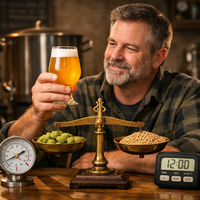
IBU vs ABV: How Bitterness and Alcohol Are Engineered for Synergy
Posted by Matteo Lahm on 22nd Feb 2026
When you look at a beer label, it is tempting to treat ABV and IBU as separate statistics. Alcohol by Volume tells you how strong the beer is. International Bitterness Units tell you how bitter it will be. Two clean numbers. Two independent measurements.
But if you think of them as separate dials that operate independently, you are not seeing the whole picture.
Alcohol and bitterness do not simply coexist in your beer. They actively influence one another. Alcohol changes how bitterness is perceived. Bitterness changes how alcohol is experienced. Body, residual sugar, hop oils, and fermentation character all sit between them, shaping how they interact on your palate. If you design your recipe as though ABV is one target and IBU is another unrelated target, you risk building a beer that fights itself.
Balance is not just something you build. It is something that emerges from how these forces work together. By better understanding this relationship and how to guide it, you will have more control over your overall flavor outcomes.
All grain and extract brewers must approach balance differently because the nature of their ingredients dictates where control lives. If you brew all grain, you shape fermentability at the mash, adjusting temperature to influence attenuation, body, and ultimately how bitterness and alcohol interact. If you brew with extract, that enzymatic work has already been done for you, so your leverage shifts to yeast selection, gravity management, specialty grain additions, and hop timing. The destination may be the same, but the path to balancing ABV and IBU depends on the raw materials you start with.
If you brew all grain, that interaction begins in the mash tun. When you choose a lower mash temperature, around 62 to 65°C, you promote beta amylase activity and create more fermentable sugars. Your yeast can consume more of those sugars, giving you higher attenuation, higher ABV, and a drier finish. If your beer finishes dry, bitterness will feel sharper and more assertive because there is less residual sweetness to buffer it.
If instead you mash higher, around 67 to 70°C, you produce more dextrins that yeast cannot ferment. Your final ABV may be slightly lower, but your body and sweetness increase. That sweetness softens hop bitterness. The exact same 50 IBUs can feel crisp and biting in a dry beer, yet rounded and integrated in a fuller one. The numbers have not changed. Your perception has.
If you brew with extract, your mash variables are largely predetermined by the manufacturer. You cannot directly manipulate enzyme activity. But you still control how alcohol and bitterness interact. If you select a highly attenuative yeast, you dry the beer out and make bitterness more pronounced. If you choose a lower attenuating strain, you retain sweetness that cushions hop intensity. If you steep specialty grains or incorporate dextrin malts, you influence mouthfeel and sweetness, which in turn reshapes how bitterness and alcohol present themselves.
When you move into the boil, you begin forming measurable bitterness. If you add hops at 60 minutes, you generate significant iso alpha acids and build structural bitterness. If you add hops later, you emphasize flavor and aroma. If you dry hop, you add aromatic compounds without increasing IBUs. But here again, alcohol changes the equation. Ethanol acts as a solvent for hop oils. If your ABV is higher, hop aromatics may appear more intense and more expressive.
Boil gravity matters as well. If your wort is high gravity, hop utilization decreases. You extract fewer IBUs from the same amount of hops. If you compensate with larger additions, you increase measured bitterness. Yet if your final beer carries higher alcohol and residual sugars, that bitterness may feel smoother than the number suggests.
If you brew extract with partial boils, you must pay attention to concentration effects. A dense boil reduces hop efficiency. If you add part of your extract later in the boil, you lower kettle gravity during primary hop additions and produce cleaner, more predictable bitterness.
Fermentation ties everything together. If your yeast attenuates aggressively, your beer dries out and bitterness sharpens. If attenuation is lower, sweetness rounds the edges. If fermentation temperature produces esters, those fruit notes may amplify or compete with hop character. Alcohol itself adds warmth and weight, which can either harmonize with bitterness or make it feel harsh if the structure is thin.
When you look at ABV and IBU as isolated measurements, you see numbers. When you understand how they influence one another, you see structure.
A Systemic Framework for Designing ABV and IBU Together
1. Start With Interaction, Not Isolation
-
Do not set ABV and IBU targets independently.
-
Decide how dry or full you want the finish.
-
Consider how alcohol will amplify aroma and reshape bitterness.
2. Shape Fermentability Intentionally
-
If you brew all grain, adjust mash temperature to control attenuation.
-
If you brew extract, choose yeast strains strategically.
-
Focus on expected final gravity, not just original gravity.
3. Engineer Bitterness With Context
-
Use early hop additions for structural bitterness.
-
Use late additions and dry hopping for expressive aroma.
-
Adjust for high gravity or partial boils to maintain hop efficiency.
4. Design for Perception
-
Remember IBUs measure chemical concentration, not sensory impact.
-
Drier beers make bitterness feel sharper.
-
Higher alcohol and residual sweetness soften bitterness perception.
5. Evaluate the Relationship
-
Compare gravity and IBUs together, not separately.
-
Ask whether bitterness structurally supports the alcohol level.
-
Taste critically and refine future batches with interaction in mind.
If you treat ABV and IBU as independent targets, you design in fragments. You chase a gravity number on one side and a bitterness number on the other, hoping they will somehow reconcile themselves in the glass. Sometimes they will. Often they will not. You end up with a beer that feels disjointed, where the alcohol shows up as heat without structure, or the bitterness lands sharp and angular without support. The recipe may look correct on paper, yet the experience feels incomplete. That is what happens when you design by isolated metrics instead of by relationship.
If you treat ABV and IBU as interacting structural forces, you begin designing with intention. You start asking better questions. If you raise the ABV, what will support it? More residual body? A softer bitterness profile? If you push bitterness higher, will the finish be dry enough to let it shine cleanly, or sweet enough to round its edges? You stop thinking in terms of hitting numbers and start thinking in terms of shaping perception. Every decision in your mash tun, your kettle, and your fermenter becomes part of a cohesive plan.
Bitterness and alcohol are not separate levers you pull in isolation. They are partners that define tension, balance, and flow. Alcohol brings warmth, weight, and aromatic lift. Bitterness brings structure, precision, and length to the finish. When they are aligned, the beer feels composed. The bitterness sharpens the contours of the malt. The alcohol carries hop aroma upward and outward. The finish resolves cleanly, inviting the next sip. Nothing feels accidental.
If you want balance in your glass, you must engineer these forces to move together. You must design fermentability with hop structure in mind. You must schedule your hops knowing how dry or sweet your beer will finish. You must choose yeast not only for attenuation, but for how it will shape the interaction between alcohol and bitterness.
When you do that, your beer stops feeling like a collection of ingredients and starts feeling like an integrated work. The numbers on the label become reflections of intentional design, not lucky outcomes. And when someone lifts the glass, they do not taste ABV or IBU separately. They taste the harmony you crafted.