
Protecting Wine During Extended Bulk Aging
Posted by Matteo Lahm on 15th Feb 2026
Advanced Airlock Management for Serious Home Winemakers
Bulk Aging Demands a Stable Airlock
When you decide to bulk age a wine for six, nine, or twelve months, you are choosing a chemical process that unfolds slowly and deliberately. Tannins polymerize. Harsh phenolics bind into longer chains and soften. Aromatic compounds integrate. Acidity becomes more harmonious. None of this happens overnight.
But long aging only works if the environment remains controlled. That control depends on one deceptively simple component: the airlock.
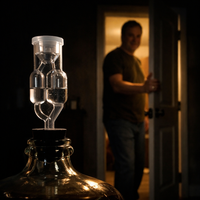
An airlock functions as a one way valve. Carbon dioxide produced during fermentation escapes through the liquid barrier while outside air is prevented from entering. During bulk aging, residual dissolved CO2 continues to off gas gradually. Pressure equalizes through the airlock. The liquid inside that chamber is the only thing maintaining the seal.
If that liquid evaporates, the barrier weakens.
Why Plain Water Evaporates So Readily
Evaporation is governed primarily by vapor pressure and intermolecular forces. Water molecules are held together by hydrogen bonds, which are relatively strong compared to many other small molecules. However, water still has a measurable vapor pressure at room temperature. That means individual molecules can escape from the liquid surface into the air.
In dry environments, the concentration gradient between liquid water and surrounding air accelerates this process. Warm temperatures increase molecular kinetic energy, allowing more molecules to overcome intermolecular attraction and enter the vapor phase. Air movement removes humid air near the surface, further driving evaporation.
Alcohol evaporates even more quickly because ethanol has a higher vapor pressure than water. Its intermolecular forces are weaker overall, so molecules escape the liquid phase more readily. In an airlock filled with vodka or another distilled spirit, you are working with a fluid that is chemically predisposed to disappear.
Over weeks or months, that loss can lower the liquid level enough to compromise the seal.
Why Vegetable Glycerine Changes the Equation
Vegetable glycerine, chemically known as glycerol, behaves very differently.
Glycerol contains three hydroxyl groups. This structure allows extensive hydrogen bonding between molecules. The result is a compound with extremely low vapor pressure at room temperature and high viscosity.
Low vapor pressure means glycerol molecules have very little tendency to escape into the air. High viscosity means molecular movement within the liquid is slower. When you mix glycerol with water in a fifty percent solution, several things happen at the molecular level.
First, the strong hydrogen bonding between glycerol and water molecules reduces the number of water molecules that can freely escape the liquid surface. The solution exhibits a lower overall vapor pressure than pure water. This phenomenon is related to colligative properties. When a nonvolatile solute such as glycerol is dissolved in water, it lowers the vapor pressure of the solvent.
Second, the increased viscosity slows diffusion of water molecules to the surface. Evaporation requires molecules to reach the liquid air interface. A more viscous solution resists internal movement, further reducing evaporation rate.
The practical result is simple. A glycerine water blend loses volume far more slowly than water alone.
An Insurance Policy Grounded in Chemistry
When you bulk age a structured red wine, you are often protecting a significant investment. Premium kits, fermentation management, oak additions, and time all contribute to the final result. Long aging exposes your wine to extended risk if protective barriers fail.
A stable airlock solution is not decorative. It is part of your oxygen management system.
As water evaporates, the liquid column in the airlock can drop below the internal baffle. Once that happens, air exchange is no longer properly restricted. Even small oxygen ingress over long periods can accelerate oxidative reactions. Acetaldehyde formation, color degradation in reds, and loss of aromatic intensity can follow.
A glycerine blend dramatically slows that risk by maintaining liquid height over extended periods.
If you choose a glycerine and distilled alcohol blend, you introduce an additional antimicrobial factor. While ethanol will still evaporate more readily than glycerol, the presence of glycerol reduces overall evaporation compared to alcohol alone. For beer, where alcohol levels are lower and pH is higher, that additional antimicrobial buffer can be meaningful.
Precision Is a Mindset
You measure gravity. You calculate sulfite additions based on pH. You manage temperature to control ester formation and fermentation kinetics. Upgrading what sits in your airlock is consistent with that same mindset.
Bulk aging is a long term chemical evolution. It deserves a stable environment.
When you replace plain water with a glycerine blend, you are not indulging in a shortcut. You are applying basic physical chemistry to reduce vapor loss and maintain an effective barrier.
Months of controlled aging depend on small details remaining stable. A properly formulated airlock solution is one of those details.