
Winemaking Is Not Baking: Why Fruit Refuses to Behave Like an Ingredient
Posted by Matteo Lahm on 6th Feb 2026
One of the most persistent misunderstandings in home winemaking is the belief that it should behave like baking. Follow a recipe. Measure carefully. Repeat the steps. Expect the same result every time.
This expectation feels reasonable. It is also fundamentally wrong.
Winemaking is not baking. Fruit is not an ingredient in the way flour or sugar is an ingredient.
The Problem With Treating Fruit as a Fixed Input
Recipes rely on consistency. They require it to function. When a recipe instructs you to use a specific weight of fruit, it quietly assumes that fruit will behave the same way every time. In reality, fruit is agricultural, seasonal, and variable by nature.
Two apples of the same variety can differ dramatically depending on ripeness, climate, soil composition, irrigation, and harvest timing. Sugar levels shift. Acidity moves. Juice yield changes. Tannin structure varies. Nutrient availability fluctuates.
These differences are not cosmetic. They are structural.
Treating fruit as a fixed input is like assuming every piece of wood has the same density and moisture content, then wondering why the finished product twists and cracks.
Why Baking Logic Fails in Fermentation
Baking is fast and predictable. Heat drives chemical reactions to completion. Errors are often small and self contained. The system is closed and short lived.
Fermentation is the opposite. It unfolds over time. It involves living organisms responding to their environment. Sugar concentration, acidity, temperature, oxygen, and nutrients all interact continuously. Yeast respond to imbalance with stress, not compliance.
A recipe can tell you what to add. It cannot tell you what conditions you have created.
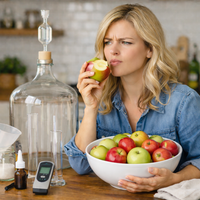
Before You Measure Anything, Taste
If you are working with fresh fruit, the most important step happens before any instrument is used.
Taste the fruit.
Is it intensely sweet or only mildly so. Is the acidity sharp and mouthwatering or flat and dull. Does the juice feel abundant or sparse. Are the skins bitter or pleasantly tannic.
Your palate cannot provide measurements. It provides context.
Fruit that tastes aggressively tart is unlikely to have a high pH. Fruit that tastes thin and watery is unlikely to produce structure without adjustment. Overripe fruit may taste sweet but lack the acidity required for balance and stability.
This is not intuition in place of science. It is orientation before measurement.
Numbers Without Context Create False Confidence
Measurement matters. Sugar and acidity determine whether fermentation succeeds or fails. They influence yeast health, microbial risk, flavor development, and stability.
But numbers without interpretation create a dangerous illusion of control.
An apple must at pH 4.8 and one at pH 3.6 exist in entirely different chemical and biological environments. The pH scale is logarithmic. A shift of one unit represents a tenfold change in acidity. That difference alters sulfite effectiveness, bacterial risk, and fermentation behavior.
Sugar behaves the same way. A few degrees of Brix can be the difference between a clean fermentation and yeast stress, sulfur production, or a stalled ferment.
A recipe does not know where your fruit begins. It can only assume.
When Precision Replaces Understanding
Recipes encourage precision without understanding. Add a fixed amount of sugar. Add a measured dose of acid blend. Add water to reach volume.
Water dilutes everything simultaneously. Sugar, acid, tannin, nutrients, and flavor all decrease together. Acid additions shift pH but do not restore structure. Sugar increases potential alcohol but also increases stress on yeast.
When corrections are made blindly, they do not solve problems. They multiply them.
This is how winemakers end up fixing symptoms instead of designing conditions.
Fermentation Is Interpretation, Not Execution
Good winemaking is closer to cooking by taste than following instructions. It requires interpretation rather than obedience.
The right question is not what the recipe says. The right question is what the fruit requires.
That answer is never the same twice.
Pasteurized juices and concentrates behave predictably because they are standardized. Fresh fruit never is. The moment you choose to ferment fresh fruit, you accept variability as part of the craft.
Wine Is Made Before Yeast Is Pitched
Most fermentation failures do not begin during fermentation. They begin with assumptions made before yeast is ever added.
Wine is made when you taste the fruit honestly. When you measure sugar and acidity accurately. When you adjust deliberately rather than reactively. When you create an environment yeast can thrive in.
Once fermentation begins, your options narrow. Design matters more than rescue.
Stop Expecting Recipes to Think for You
Recipes are references. They are starting points. They are not guarantees.
Fruit will never behave like flour. Fermentation will never behave like an oven. Wine will never reward guesswork disguised as precision.
Winemaking is not about following steps. It is about reading conditions.
Measure carefully. Taste constantly. Adjust intelligently.
That is not baking.
That is winemaking.