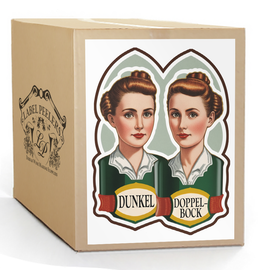
Gravity Goat Doppelbock Beer Kit – All Grain
Brand : Label Peelers
This product is eligible for up to 30% off shipping! Start saving 10% at a $50 eligible cart subtotal, increasing by 5% at $100, $150, and $225, with a maximum 30% discount at $300. Some restrictions apply.
- SKU:
- LP-Gravity-Goat-Doppelbock-All-Grain
- UPC:
- 810194955341
- Shipping:
- Calculated at Checkout


Description
Your Gravity Goat Doppelbock gives you a rich, malty doppelbock modeled on Troegs Troegenator. The combination of Pilsen Malt and Bonlander Munich Malt creates a sweet, bready backbone with biscuity notes, while Chocolate Malt contributes a delicate chocolate undertone for added complexity. Hallertau hops supply mild earthy bitterness that keeps the malt in balance. Your German Lager Yeast - SafLager 34/70 ferments clean and crisp, allowing the malt flavors to take center stage for a smooth, warming finish. The included Irish Moss helps produce a clear pour.
Your Gravity Goat Doppelbock never sits on a shelf. Your grains are crushed to order. Your ingredients are packed fresh and you don't pay for a flashy box. It's all about providing you with the freshest ingredients for you to make your best beer.
Beer Specifications
- ABV: ~8.2 %
- Original Gravity: ~1.075
- Final Gravity: ~1.013
- IBUs: ~24
- SRM: ~28
Disclaimer: All calculations are approximate.
Ingredients
Grain Bill (combined in one bag)
- 9 lbs Pilsen Malt
- 5 lbs Bonlander Munich Malt
- 1 lb Chocolate Malt
Hops (substitutions based on availability)
- 2 oz Hallertau (60 min)
Yeast (substitutions based on availability)
- 2 packets German Lager Yeast - SafLager 34/70 (recommended for high gravity)
Additives
- 5 oz Priming Sugar
- Irish Moss Combo
Instructions
Hop Schedule
- 2 oz Hallertau (60 min)
Prepare Equipment
- Thoroughly clean and sanitize all brewing equipment, including your mash tun, brew kettle, fermenter, airlock, and hoses.
- Double-check your chilling setup (e.g., immersion chiller or counterflow) because lagers benefit from a quick cool.
Mash
- Heat 6.1 gallons of water to 152°F (aim for a stable mash temp).
- Slowly stir in the Munich Malt, Pilsner Malt, and Chocolate Malt to avoid clumps.
- Mash for 60 minutes at 152°F, stirring every 15 minutes or so to maintain consistency.
Sparge
- Heat an additional 4 gallons of water to 168°F for sparging.
- Recirculate the first runnings until they run mostly clear, then begin lautering.
- Sparge slowly, rinsing the grain bed and collecting around 6.5 gallons of wort total (adjust for your system’s boil-off rate).
Boil & Hop Schedule
- Bring the collected wort to a rolling boil. Watch carefully for boil-overs early on.
- Total Boil Time: 60 minutes Keep the boil strong and steady, stirring occasionally to prevent scorching.
- 60 min: Add 2 oz Hallertau hops.
- 15 min: Add Yeast Energizer/Irish Moss Combo Packet
Cool & Transfer
- After the 60-minute boil, rapidly cool the wort to around 50°F, this step is vital for a clean lager fermentation.
- Transfer the cooled wort to a sanitized fermenter, leaving as much hot break and hop trub behind as possible.
- Top up to 5 gallons total for primary fermentation.
Fermentation
- Pitch 2 packets of German Lager Yeast at 50°F.
- Ferment at 50°F for 2–3 weeks.
- Once final gravity is nearly stable, raise the temperature to 65°F for a 2–3 day diacetyl rest, which helps remove unwanted flavors.
- Then lower the temperature to around 35°F for 3–4 weeks of lagering, if your setup allows, it refines the flavor and clarity.
Packaging
- Priming for Bottling: Boil ~2 cups water, dissolve 5 oz priming sugar, then cool.
- Gently rack your lagered beer to a sanitized bottling bucket, stirring in the sugar solution carefully to avoid oxygenation.
- Fill sanitized bottles, leaving about an inch of headspace, and cap.
- Let bottles condition at room temperature (68–72°F) for 2–3 weeks, then move them to cold storage for extended aging.
- Kegging: Transfer the beer into a sanitized keg.
- Purge the keg with CO₂ by burping it a few times.
- Set your regulator to 12 PSI at 38°F for 2–3 weeks, or use your preferred force-carbonation schedule.