
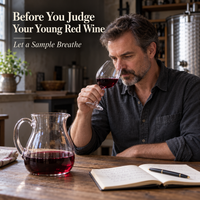
Before You Judge Your Young Red Wine, Let a Sample Breathe
Posted by Matteo Lahm on 22nd Oct 2026
A young red wine can be especially hard to read. The alcohol feels hot. The tannins are aggressive. The fruit is difficult to recognize, and the aromas seem confused. There may even be a sweetish impression when you know the wine fermented dry.
That can make you question decisions that seemed perfectly reasonable during fermentation. It can also send you into correction mode before you have a clear understanding of what you are tasting.
Before deciding what needs correcting, try a simple technique to minimize some of the noise in your glass. Give a separate sample time to breathe. You may find the wine becomes much easier to understand.
What Changed in My Pitcher
I recently tried this with my own Sangiovese Merlot, pressed less than a month earlier. This is a substantial red that stayed on the skins for two weeks. I estimate its alcohol content at about 14.8%.
Fresh from storage, it had an alcohol-like smell and a sweetish bite toward the back of my mouth. It was very unruly at first sip. I was considering whether I might eventually blend it with a lower-alcohol Merlot. But years of making wine have taught me that its first presentation tells you very little about where it will finish.
We drank some over dinner, and within about fifteen minutes, it had begun smoothing out. Over the next few hours, it changed significantly. I left the remainder overnight in a wide pitcher, where the wine was only about a centimeter deep.
Twelve hours later, it tasted much more familiar. The sweet bite had receded, and I could better recognize the acidity and overall flavor. It showed no obvious signs of oxidation. The youthful tannins still made my mouth pucker, but I could get a much better sense of the wine beneath them.
That raised a useful question. Could allowing a sample to breathe help a winemaker recognize qualities that are difficult to assess so soon after fermentation?
I repeated the experiment with at least fifteen times the volume. I tasted it immediately and then at roughly hourly intervals. Within an hour, the alcohol-like smell was noticeably reduced. After two hours, the improvement was dramatic. By four and a half hours, I would have drunk it without blending.
A lingering sweetish sensation remained, so every awkward characteristic had not disappeared. Nevertheless, my assessment was quite different.
The batch itself had not changed. My understanding of it had.
Why a Young Wine Can Present Differently
Recently fermented wine can retain dissolved carbon dioxide even when you cannot see bubbles. That gas affects taste and mouthfeel. As it escapes, the wine can feel less prickly, and the relationship between its components can seem different.
Volatile compounds also escape as a sample sits. Some fermentation-derived sulfur compounds, if present, may dissipate and make the fruit easier to recognize. Oxygen exposure can initiate chemical reactions, while changes in temperature can influence what you smell and taste.
Alcohol can evaporate too, particularly from a shallow sample left exposed for hours. That deserves consideration when interpreting the result. Smelling less alcohol, however, does not establish how much alcohol the wine has lost.
I cannot tell you how much each process contributed to my samples. What I can tell you is that the improvement happened twice, including with a considerably larger volume. The wine became more enjoyable, and its flavor became easier to assess.
That is enough to make the exercise useful, provided we understand what it can tell us.
Getting a Better Sense of What Is There
When a wine is very young, its most forceful characteristics can dominate your attention. You notice heat, tannin, or an unfamiliar fermentation aroma before you can distinguish the fruit and other subtleties.
Bold young reds can consequently seem almost boring and one-dimensional. There may be plenty going on, but you cannot easily separate it.
Giving a sample time to breathe offers another perspective on those existing qualities. As its presentation changes, you may find that the fruit becomes more recognizable or the acidity easier to assess. You can begin to understand how the components relate to one another.
Some of those qualities may become clearer during maturation. That does not make the exposed sample a prediction of the finished wine. Aging involves changes in tannins, pigments, and aromas that a few hours in a pitcher cannot reproduce.
For my wine, the exercise gave me a reason to leave the blending decision open. It did not establish that the alcohol level was ideal or that the acidity needed no attention. Those questions still deserve their own measurements and tasting trials.
It showed me that the fresh sample alone was an incomplete basis for deciding.
Try It With Your Own Sample
This exercise is intended for very young, substantial reds being made for maturation, especially those whose alcohol seems prominent. Alcohol content alone does not determine aging potential. Structure, balance, and the condition of the wine matter too.
Start with approximately 250 to 500 milliliters in a clean, odor-free pitcher that leaves an exposed surface. Avoid using just a shallow splash, since evaporation can have a greater influence relative to the amount of wine.
Taste immediately and note what dominates. Is there alcoholic heat, prickliness, an unfamiliar smell, or fruit you cannot quite distinguish?
Leave the sample in a cool room away from sunlight and strong odors. Taste after fifteen to thirty minutes, then at roughly hourly intervals. Keep the tasting temperature reasonably consistent. If you stir, note that too, since stirring encourages gas release and changes air contact.
Follow the individual characteristics. Does the sharp smell recede? Does the fruit become clearer? Is the acidity easier to recognize? Does improvement slow down, or does the wine eventually begin losing freshness?
There is no required overnight waiting period. You are observing how your sample responds. Keep the main batch protected, and do not return the exposed sample to it.
Give Yourself Time to Understand the Wine
The useful result is a better-informed judgment. You may discover appealing qualities that were initially difficult to recognize. You may also find that a particular imbalance remains after the sample settles down.
Either observation helps. An improvement can encourage patience, while a persistent concern can guide further testing. Neither replaces checking the wine’s chemistry or attending to necessary cellar care.
I will let my main batch mature and continue tasting along the way. If it eventually needs blending, I can make that decision with a more developed wine in front of me.
When you have invested so much work in a wine, give yourself ample time to understand it. A sample allowed to breathe may help you recognize more of what is already there and make your next decision with greater confidence.