
How Much Sulfite Should You Add to Wine? Start With pH
Posted by Matteo Lahm on 4th Oct 2026
A quarter teaspoon here. An eighth teaspoon there. A little more before bottling. But did you know that adding sulfites this way, without knowing your wine’s pH, could put your entire batch at risk?
For many home winemakers, that is the sulfite routine. It might come from a recipe, a friend, or a family tradition. The wine usually turns out fine, though the results may vary.
But think about everything you put into a batch. You buy the fruit, prepare equipment, manage fermentation, press, rack, clean, and wait. By the time you open a bottle, you have invested money, hours of work, and months of patience.
Risking that investment over a missing pH reading or an unsuitable sulfite addition seems hard to justify.
I want to help you make more targeted additions without buying a roomful of equipment or turning your cellar into a laboratory. The starting point is simple: know your pH.
Your pH helps establish how much protection to aim for. Your batch size, previous additions, and winemaking stage help determine how much powder to add. A cookie cutter routine cannot account for all of that.
Same spoonful, different protection
Sulfites help protect wine from spoilage organisms and oxidation. Their effectiveness against unwanted microbes depends strongly on pH.
At lower pH, a greater proportion of the available sulfite provides antimicrobial protection. As pH rises, that proportion gets smaller.
At the same available sulfite level, wine at pH 3.5 has approximately twice as much of the active antimicrobial form as wine at pH 3.8. Three tenths might look insignificant on a meter. In your carboy, it matters.
You measured the same spoonful, but you did not necessarily give the wine the same protection.
Your measuring spoon has no idea what is in that carboy.
Different weather, different chemistry
Even your favorite grape from the same supplier can arrive with a different pH next season. Different weather, different chemistry.
Last year’s successful batch is encouraging. It is not a measurement of this year’s wine.
Kit makers have instructions developed for a particular product and finished volume. Follow them, including the water measurements. Fresh grapes and other fruit require more individual attention.
Your grapes did not read your recipe. Your additions need to account for the wine they actually produced.
Give the teaspoon a well earned retirement
Was that quarter teaspoon level or slightly rounded? Was the powder loosely settled or packed down?
A gram scale makes additions more consistent. Instead of recording “a little less than an eighth teaspoon,” you can record “0.50 grams.”
Choose a precision scale that reads to 0.01 gram and reliably measures small quantities. An ordinary kitchen scale displaying only whole grams is too coarse for additions below one gram.
These small scales are available in kitchen stores, some supermarkets, and online. Weighing the powder takes another minute.
What does the powder contribute?
Most home winemakers use potassium metabisulfite powder. Approximately 57 percent of its weight supplies sulfur dioxide, the substance behind sulfite protection.
In a 23 liter batch, approximately six US gallons:
-
0.50 grams supplies about 12 milligrams per liter of sulfur dioxide.
-
1.00 gram supplies about 25 milligrams per liter.
-
1.50 grams supplies about 37 milligrams per liter.
-
2.00 grams supplies about 50 milligrams per liter.
These are examples of what weighed additions contribute, not recommendations for your batch.
Some sulfite attaches to substances in the wine and becomes less available for protection. Your record tells you what went in, but not exactly what remains available.
That distinction matters when planning later additions.
Too much can announce itself before the first sip
I have overdone a sulfite addition myself, and the smell was awful. Think burnt matchbooks. You bring the glass toward your face expecting fruit and get a sharp smell that makes you want to pull it away.
That is a memorable lesson in why more is not always better.
Lower pH wine needs less available sulfite to achieve the same antimicrobial protection. Excessive sulfur dioxide can produce a pungent smell and nasal irritation that interferes with enjoying the wine.
That was my experience with an excessive addition. Other sulfur faults can smell unpleasant too, so smell alone is not a diagnosis.
Too little can let the wine slip away
Insufficient protection may be quieter at first.
Later, the fruit seems duller. The color looks tired. Perhaps vinegar character develops or an unexpected haze appears. The wine you were waiting to improve is heading in the wrong direction.
Higher pH wine with no added sulfites presents a greater challenge. Certain spoilage organisms grow more readily, while additional sulfite protection is absent.
Failure is not inevitable. But aging gives spoilage and oxidation time to undo your work too.
Making red wine? Account for MLF
Malolactic fermentation, or MLF, converts sharper malic acid into softer lactic acid. You may add a bacterial culture, or it may happen spontaneously.
If you want MLF, your sulfite timing needs to accommodate it. The usual approach is to hold off on the main addition after alcoholic fermentation until MLF is confirmed complete. A quiet carboy does not prove completion.
Any smaller addition considered before or during MLF needs guidance appropriate to the wine and culture. Previous sulfite additions matter, and even bound sulfite can affect the bacteria. Calculating the powder quantity alone cannot establish a harmless dose.
After MLF, measure pH again. It commonly rises, potentially increasing the sulfite requirement. Then establish protection without unnecessary delay. For red winemakers, this is a particularly important checkpoint.
Let an AI help with the arithmetic
An AI chat can help explain calculations and develop an estimated management plan. Give it the details rather than asking, “How much sulfite for six gallons?”
Try this:
“I have [volume] of [wine type] made from fresh fruit, with a current pH of [reading]. Alcoholic fermentation is finished. MLF is [not intended, planned, underway, or confirmed complete]. I plan to age it for [time] in [vessel]. Previous potassium metabisulfite additions were [dates and grams]. Help me assess an estimated sulfite plan. Express quantities in grams, cite reliable winemaking sources, identify missing information, and explain your assumptions.”
If MLF is complete, use the pH measured afterward.
Check the arithmetic and sources. An AI cannot determine remaining protection from pH and addition history alone. A precise gram quantity may still depend on an uncertain assumption.
Keep track through bottling
Record dates, pH, actual volume, additions, and transfers. Ask whether purchased fresh juice has already received sulfite.
Protection changes during aging through binding and oxygen exposure. Review your records and reassess before bottling rather than automatically adding another spoonful.
Practical estimation improves your decisions, but it does not verify how much protection remains.
Start with a pH meter
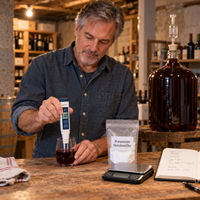
If you make wine from fresh fruit, especially wine intended for aging, consider purchasing a pH meter. Learn to calibrate it properly and use it alongside a precision gram scale.
These are modest additions compared with the investment already sitting in your carboy.
You cannot reliably decide how much sulfite your wine needs without knowing its pH. Measure it, weigh your additions, and keep records. After carrying a batch through all that work, this small additional effort makes sense. Give your wine a better chance to reach the bottle in good condition and reward the wait.