

What Are Noble Hops?
Posted by Dale Hynes on 14th Nov 2026
Noble Hops Guide: Varieties, Flavor Profiles, Brewing Uses, and Substitutes
From traditional European lagers to modern hop breeding, these four varieties offer lessons that can improve almost any beer.
My first experience with Noble hops came while brewing a Spaten clone. It was also my first attempt at a lager, using Hallertauer Mittelfrüh hops and SafLager W-34/70 yeast. Temperature control required clearing out the spare refrigerator, but the beer turned out pretty well. That first lager taught me something I hadn't fully appreciated: a hop doesn't need an aggressive aroma to make a noticeable difference in a beer. Sometimes choosing a more restrained variety is exactly what makes a recipe work.
With today's selection of hops offering everything from tropical fruit to intense citrus, it's easy to overlook the traditional varieties that helped shape brewing. But understanding Noble hops can make you a more versatile brewer, even if German lagers aren't your thing.
 What Makes a Hop Noble?
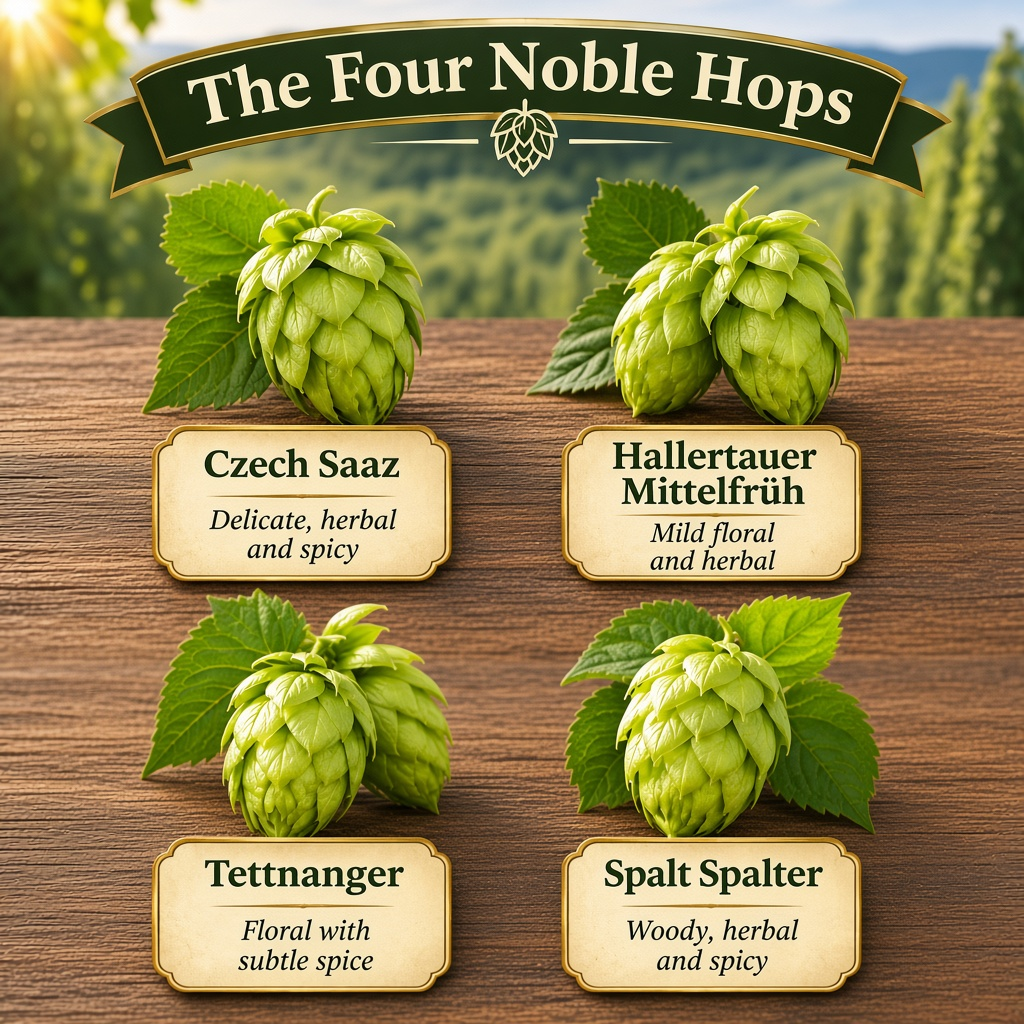
Four traditional European varieties carry the Noble designation: Czech Saaz, Hallertauer Mittelfrüh, Tettnanger, and Spalt Spalter. Saaz is known for delicate herbal, earthy, and spicy notes that helped define Czech Pilsners. Hallertauer Mittelfrüh contributes mild floral and herbal characteristics, making it ideal for German Helles, lagers, and wheat beers. Tettnanger offers floral and subtly peppery qualities, while Spalt Spalter brings gentle woody, herbal, and spicy notes that complement malt-forward beers.
"Noble" isn't an official botanical classification. The designation reflects these varieties' regional heritage, historical importance, and distinctive brewing characteristics. Their real value is the ability to create recognizable hop flavor without overwhelming other ingredients.
Understanding Bitterness Beyond Alpha Acids
Noble hops generally contain relatively low alpha acid levels, often around 2-6%, meaning larger additions are needed to achieve the same bitterness as high-alpha varieties. They also tend to contain relatively low cohumulone levels and essential oils rich in humulene, associated with herbal, woody, and spicy aromas.
Low cohumulone is frequently credited with smoother bitterness, although wort composition, hopping schedules, and other compounds also influence perception. Two beers with identical calculated IBUs can taste noticeably different depending on the hops and how they're used. Understanding these differences helps brewers make decisions beyond simply comparing alpha acid percentages.
Using Noble Hops to Improve Your Brewing
Noble hops are particularly useful when you want malt and yeast characteristics to remain prominent without sacrificing hop flavor. Early boil additions provide bitterness, while additions during the final 10-20 minutes contribute flavor and aroma. Flameout additions can further emphasize their delicate aromatic qualities. Their lower alpha acid percentages may require larger quantities, potentially increasing wort losses, but the resulting character can be worth the tradeoff.
One way to explore these characteristics is to simplify a familiar recipe. Try brewing a Blonde Ale using only Saaz, allowing its subtle herbal and spicy qualities to become more apparent. Hallertauer Mittelfrüh works beautifully in a Munich Helles (the best lager style, in my opinion) or Amber Lager, where its restrained character allows the grain bill to remain the focus. You can even experiment outside traditional styles by replacing an aggressive citrus hop with Tettnanger in an American Pale Ale for a different interpretation.
Another worthwhile experiment is comparing early and late additions of the same Noble variety. Keeping the recipe consistent while changing the hopping schedule demonstrates how timing influences bitterness, flavor, and aroma without requiring expensive ingredients or complicated equipment.
Noble, Noble-Style, or Noble Descendant?
Understanding these distinctions is useful when choosing substitutions. True Noble hops are the four traditional European varieties, making them excellent starting points for classic beer styles. Noble-style aroma hops have similar floral, herbal, or spicy characteristics but aren't necessarily genetically related. They can provide comparable flavors when traditional varieties are unavailable.
Genetic descendants are varieties developed using Noble hop ancestry. They share genetic material with traditional varieties but may offer different aromas, alpha acid levels, or growing characteristics. A hop can be both Noble-style and a genetic descendant without being one of the original four.
How Noble Genetics Created Modern Alternatives
Hop breeders have used traditional European genetics to develop varieties with improved agricultural performance while retaining desirable brewing characteristics. Hallertauer Mittelfrüh contributed to the development of Mt. Hood, Liberty, and Crystal, while Saaz ancestry appears in Sterling and Ultra. These newer varieties demonstrate how traditional hop genetics can be adapted to produce different characteristics while preserving some of the qualities brewers appreciate in their ancestors.
These connections are useful when substituting hops. Mt. Hood can provide a Hallertauer-like character when Mittelfrüh is unavailable, while Sterling offers a Saaz-inspired profile with additional citrus nuances. However, shared ancestry doesn't guarantee identical flavor. Compare aroma descriptions and alpha acid percentages before substituting, adjusting quantities to maintain your intended bitterness.
For example, if a recipe calls for 1 ounce of Hallertauer Mittelfrüh at 4% alpha acids, but you're substituting Mt. Hood at 6%, you'd use approximately 0.67 ounces for the same boil time to maintain a similar bitterness contribution. This simple adjustment helps prevent unexpected changes in bitterness, although differences in hop character will still influence the finished beer.
A Simple Experiment Worth Trying
One of the best ways to appreciate Noble hops is to brew a familiar recipe twice, changing only the hop variety. Compare Hallertauer Mittelfrüh with Mt. Hood, or Saaz with Sterling. Keep the grain bill, yeast, fermentation temperature, and calculated IBUs consistent so differences in hop character become easier to identify.
Noble hops aren't simply ingredients for recreating historical European beers. They're tools for understanding balance, developing your palate, and making better recipe decisions. Whether you're brewing your first lager or refining a familiar recipe, exploring these varieties can change how you approach hop selection.
Sometimes becoming a better brewer isn't about adding more ingredients. It's about understanding what each one brings to the glass.