
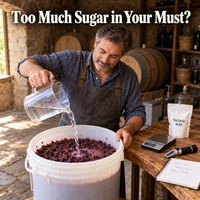
Too Much Sugar in Your Wine Must?
Posted by Matteo Lahm on 16th Oct 2026
How and When to Use Water or Acidulated Water
Too much sugar in your must can create a problem that good intentions will not solve. Yeast have limits, and a must with excessive sugar can struggle to ferment completely or produce more alcohol than the fruit can comfortably support. In my earlier article about my Sangiovese and Merlot, I mentioned using acidulated water to lower sugar concentration before fermentation. That technique deserves a closer look.
Perhaps your grapes arrived with unusually high Brix or you miscalculated a sugar addition to fresh fruit. Maybe you did not accurately measure water additions to concentrate and have already balanced acidity. In any of these cases, the question is how to correct the excess while retaining as much of the fruit's character as possible.
Water can help, but it changes more than sugar. Knowing when to use plain water and when to add acid is part of making a responsible correction.
When a water addition makes sense
The fruit should guide your winemaking. You may begin with a particular wine in mind, then discover that your grapes call for a different approach. Being willing to change direction is part of the job.
However, accepting the fruit does not mean ignoring excessive sugar. High starting concentrations can stress yeast, and rising alcohol may stop fermentation before the sugar is consumed. A strain's stated alcohol tolerance is an estimate under suitable conditions, not a promise. Even successful fermentation can leave an excessively alcoholic wine whose fruit and structure cannot balance it. This is where a measured water addition may become necessary. There is no single Brix cutoff for every fruit, yeast, and fermentation.
Confirm the problem before correcting it. Thoroughly mix the must, collect a representative juice sample, and check Brix with a suitable instrument, following its temperature correction instructions. Consider potential alcohol alongside the yeast's capabilities and the fruit's composition. With concentrates, first check the prescribed dilution. The aim is a sound starting must, with only as much correction as necessary.
This discussion concerns corrections before fermentation. Once alcohol is present, ordinary Brix readings no longer directly represent remaining sugar.
What water changes
Water lowers sugar concentration by increasing the amount of liquid containing that sugar. It also dilutes the acids and other dissolved components already present.
That means a correction can affect flavor concentration, body, color, and tannin. Adding acid can address part of the acidity change, but it cannot replace diluted fruit character.
The important comparison is the percentage added, rather than the batch size. One quart added to five gallons is a much greater intervention than one quart added to fifty gallons.
Every addition has a cost. Correct the excessive sugar while preserving as much of what the fruit offers as possible. Substantial dilution deserves particular caution.
When plain water may be enough
A modest water addition may leave the must with entirely appropriate acidity. If acidity was excessive to begin with, some dilution may even be helpful.
This is particularly relevant to fruit wines. High sugar does not automatically mean low acidity, and different fruits can present very different starting conditions.
Check both pH and titratable acidity, commonly called TA. They describe different aspects of acidity. pH helps guide decisions about microbial stability and sulfite protection, while TA helps assess acid balance alongside taste. You cannot reliably calculate one from the other.
Do not automatically add acid simply because you are adding water.
When acidulated water helps
Acidulated water is water containing a measured amount of dissolved winemaking acid.
It becomes useful when a necessary water addition would leave the must with insufficient acidity, or when excessive sugar and insufficient acidity both require correction. Larger additions make acid management more consequential, but the starting acidity still determines whether acid is needed.
Tartaric acid is generally the starting choice for grape must. For other fruit wines, choose the acid with the fruit, recipe, and fermentation plan in mind. An acid blend is not automatically interchangeable with tartaric acid.
The goal is suitable acidity in the combined must. Bringing the water itself to a particular pH does not establish how much acid the must needs.
Calculate the water first
Brix expresses soluble solids as a percentage by weight, so a calculation using weights avoids the density differences between juice and water.
For an illustrative calculation, suppose you have 10 kilograms of juice at 28 Brix and have assessed 24 Brix as a suitable corrected starting point for that particular must. These are example values, not universal intervention thresholds.
Use this relationship:
Water weight = starting juice weight × (starting Brix ÷ target Brix − 1)
The calculation is:
10 × (28 ÷ 24 − 1) = 1.67 kilograms of water
That is approximately 1.67 liters of water. The example assumes uniform juice before fermentation and no other additions.
For calculations in gallons, use a winemaking dilution calculator that accounts for density. Simply substituting gallons for kilograms in this equation gives an approximation.
With crushed grapes or fruit, the fermenter's contents include solids. Do not treat the entire occupied volume as juice. Estimate the liquid quantity carefully, then verify the correction through measurements.
Determine the acid separately
There is no universal number of grams of acid per gallon of added water.
As a simplified illustration, a must with a TA of 6 grams per liter would fall to roughly 5 grams per liter if you added 20 percent of its original liquid volume as plain water. That describes dilution, not a guaranteed pH change.
Adding tartaric acid to that water at 6 grams per liter would theoretically preserve the original TA before chemical interactions. But preserving the original TA is only appropriate if it was suitable in the first place.
Use a small trial with representative juice and proportional water and acid additions. Measure the result before treating the batch. Weigh acid with a gram scale rather than estimating teaspoons.
Add gradually and check again
Use clean, suitable drinking water without objectionable flavors. Address chlorine or chloramine if present, and use sanitized equipment.
Add less than the full calculated correction initially. If acid is included, dissolve the measured amount before mixing it thoroughly into the must.
Recheck Brix, pH, and TA before proceeding. Record the water and acid already added so later adjustments account for them.
Continue monitoring as fermentation progresses. Acid balance can change during fermentation, and planned malolactic fermentation must also inform your decisions.
Work with the fruit and respect its limits
Winemaking requires flexibility. The fruit may call for a different wine from the one you imagined, and recognizing that is part of making it well. Water addition also has limits: continued dilution cannot turn every batch into any style you choose.
When sugar is excessive, however, leaving it alone can jeopardize fermentation and the wine's balance. A measured correction can give yeast more workable conditions while retaining as much fruit character as possible. Whether that calls for plain water or acidulated water depends on the must's actual measurements.
You have already invested time, money, and effort in this batch. Let the fruit guide your decisions, recognize when a correction is necessary, and make that correction carefully. The goal is to help the fruit become the best sound wine it can reasonably produce.