Classic Mead Kit 5 Gallon with Equipment (Glass Carboy)
Brand : Label Peelers
This product is eligible for up to 30% off shipping! Start saving 10% at a $50 eligible cart subtotal, increasing by 5% at $100, $150, and $225, with a maximum 30% discount at $300. Some restrictions apply.
- SKU:
- MEAD5-KIT-G
- Shipping:
- Calculated at Checkout


Honey only. This Classic Mead Kit makes 5 gallons of traditional mead from nothing but honey, water and yeast. 15 lb (three 5 lb jugs) of Burleson's Wildflower Natural Honey is fermented with Lalvin 71B, which finishes around 13% ABV and semi-sweet, leaving the honey's own floral character up front.
Make it your own at bottling. Once your mead is clear and stabilized, you can add one of our all-natural flavorings right before bottling. A flavoring adds aroma and a subtle layer of flavor on top of the honey without restarting fermentation. Choose one from the Mead Kit Flavorings list, or leave it at None for a pure traditional mead.
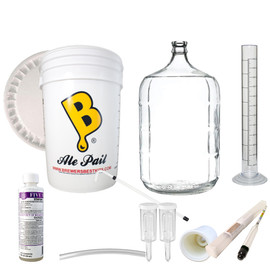
Everything in one box. This whole-package kit includes the Classic Mead 5 Gallon ingredients plus the Mead Equipment Kit 5 Gallon (Glass Carboy), so you can start your first batch without having to pick out any equipment.
Glass or plastic? This version comes with a 5 gallon glass carboy and the Drilled Universal Carboy Bung that fits its neck. Glass lets in no oxygen at all and never scratches or holds odors, so it is the best choice if you plan to age your mead for many months. It is heavier and needs careful handling: carry it full only with a carboy handle or carrier, never by the neck. Want something lighter and less expensive? The Classic Mead Kit 5 Gallon with Equipment is the same kit with a Vintage Shop 5 Gallon Plastic Carboy.
What's in the Box
Ingredients
- 3 x Burleson's Wildflower Natural Honey 5 lb Jug
- 2 x Lalvin 71B Wine Yeast
- Yeast Nutrient 8 oz
- Yeast Energizer 1 oz
- Potassium Metabisulfite 2 oz
- Potassium Sorbate 1 oz
Equipment
- 6.5 Gallon Fermenting Bucket
- 6.5 Gallon Fermenting Bucket Grommeted Lid
- Glass Carboy 5 Gallon
- Drilled Universal Carboy Bung
- 2 x Econo-Lock Airlock
- 1/2" Easy-Siphon Vintage Shop
- 1/2" Siphon Tubing 5 feet
- Triple Scale Hydrometer
- 12" One-Piece Plastic Hydrometer Test Jar
- Five Star Star San 8 oz
The yeast nutrient and energizer keep a honey-only fermentation healthy. Potassium metabisulfite and potassium sorbate stabilize the finished mead so you can add a flavoring or back-sweeten before bottling.
Water (spring or distilled) and bottles are not included.
Instructions
You will also need:
- About 4 gallons of spring water (or distilled water)
- A long spoon, measuring spoons and a small cup or jar for the yeast
- About 25 wine bottles (750 mL) with corks or caps, for bottling
- Optional: extra honey for back-sweetening, and a Mead Kit Flavoring
- Clean and sanitize. Clean and sanitize everything that will touch the mead with the included Star San sanitizer: 1 oz (2 Tbsp) per 5 gallons of water, 1 to 2 minutes contact, drain, no rinse needed. Do this before every step that touches the mead.
- Warm the honey. Set the three honey jugs in a sink of warm water for 10 to 15 minutes so the honey pours easily. Do not boil the honey; heat drives off its floral aroma.
- Mix the must. Pour the honey into the 6.5 Gallon Fermenting Bucket. Add about half of the water, warm (around 100°F), and stir until no honey is left on the bottom. Rinse the honey containers with a little of the water to get it all. Add cool water to bring the total to 5 gallons (the honey is about 1 1/4 gallons, so you will add about 3 3/4 gallons of water). Stir hard for 2 to 3 minutes to mix in air.
- Take the starting gravity. Take a reading with the Triple Scale Hydrometer in the test jar and write it down. Expect about 1.100 to 1.110. This is your original gravity (OG). Let the must reach 65 to 75°F before adding the yeast.
- Rehydrate the yeast. In a clean cup, sprinkle both packets of Lalvin 71B onto about 1/2 cup (100 mL) of water at 95 to 99°F (35 to 37°C). Wait 20 minutes, then stir gently. Stir in a few spoonfuls of must and wait 5 minutes so the yeast is within about 18°F (10°C) of the must temperature. Pitch within 45 minutes of starting.
- Feed the yeast (staggered nutrients). Honey has very little of the nitrogen yeast need, so the Yeast Nutrient and Yeast Energizer go in 4 times. Each time, first stir the must gently to let gas out (it can foam), then stir in the nutrients dissolved in a little must or water.
• Addition 1, right before pitching the yeast: 1 1/4 tsp nutrient + 1 tsp energizer
• Additions 2, 3 and 4, at 24, 48 and 72 hours: 1 1/4 tsp nutrient + 1/2 tsp energizer each
That is 5 tsp nutrient and 2 1/2 tsp energizer in all (the label rates of 1 tsp and 1/2 tsp per gallon). If the gravity has already dropped below about 1.070, skip the rest of the additions. - Ferment. Close the 6.5 Gallon Fermenting Bucket with the Grommeted Lid and an Econo-Lock Airlock (fill the airlock to the line with water or sanitizer). Lalvin 71B works from 59 to 86°F; for the cleanest honey flavor keep it around 62 to 70°F, out of sunlight. For the first week, gently stir once or twice a day to release gas. Bubbling usually starts within 1 to 2 days.
- Check that fermentation is done. After 2 to 4 weeks, when bubbling has slowed to almost nothing, take a reading every few days. Fermentation is done when the gravity stays the same for 3 days in a row, usually somewhere around 0.996 to 1.005. Never bottle mead that is still fermenting.
- Rack off the sediment. Siphon the mead into the 5 Gallon Glass Carboy using the 1/2" Easy-Siphon with the 1/2" tubing, leaving the yeast layer (lees) behind. Fit the Drilled Universal Carboy Bung and the second airlock. Glass is slippery when wet, so move the carboy with a handle or carrier and avoid sudden temperature changes. Keep the level up into the neck to limit air contact; if you are a little short, that is fine for now.
- Clear and age. Let the mead clear in a cool, dark spot for 2 to 3 months or longer. Honey meads are slow to clear, so be patient. If a new layer of sediment forms, rack again into a clean, sanitized container. It is ready when you can read print through it.
- Stabilize. Once it is clear and the gravity has not changed, dissolve 1/4 tsp Potassium Metabisulfite and 2 1/2 tsp Potassium Sorbate, each in a little cool water, and gently stir them into the mead without splashing. Always use the two together. Wait at least 24 hours before sweetening or bottling.
- Back-sweeten (optional). Taste it. If you want it sweeter, dissolve extra honey (not included) in an equal amount of warm water. Start with about 3/4 cup (10 oz), stir it in gently, taste, and add more if you like. Then wait 1 to 2 weeks and check that the gravity holds steady before bottling.
- Add a flavoring at bottling (optional). Rack the mead into the clean, sanitized 6.5 Gallon Fermenting Bucket and stir in a Mead Kit Flavoring. One 4 oz bottle flavors up to 5 gallons. Start with half the bottle (2 oz), taste, and add more up to the whole 4 oz bottle. Stir gently.
- Bottle. Sanitize about 25 wine bottles (750 mL, not included). Siphon the mead into them, leaving about 1/2 inch of space below the cork or cap, and seal. This is a still (not sparkling) mead. Store the bottles cool and dark; stand corked bottles upright for 3 days, then lay them on their side.
- Age and enjoy. Your mead is drinkable after a couple of months in the bottle, but it gets smoother with 6 to 12 months of aging. To find the strength: (OG - final gravity) x 131.25 = ABV %. Expect about 13 to 14% ABV.