Base Malt Is the Architect. Specialty Malt Is the Designer.
Posted by Matteo Lahm on 18th Jul 2026
One Builds the Beer; the Other Adds the Finishing Touches
Specialty grains tend to get all the attention.
They have memorable names, dramatic colors, and obvious jobs. Chocolate malt adds roast. Crystal malt adds caramel. Black malt can turn a beer dark with one decisive scoop. Base malt, meanwhile, is often treated like the lumber underneath a house: necessary, plentiful, and not especially interesting.
That is a mistake.
Base malt usually makes up most of your grain bill. It provides the majority of the fermentable sugar, but it also sets the foundation for flavor, aroma, color, body, foam, mouthfeel, and fermentation performance. It influences how the beer handles hops, yeast, specialty grains, and adjuncts before any of those ingredients get a chance to show off.
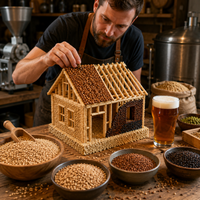
Specialty grains may decorate the room, but base malt determines what kind of house you are building.
American Pale Malt and 2-Row
Standard American pale malt or 2-row is usually light, clean, highly fermentable, and strong in diastatic power. It is a practical choice when you want the hops, yeast, or specialty grains to provide most of the beer’s personality.
Briess pale malt is a dependable option for American pale ales, IPAs, stouts, cream ales, and many general-purpose recipes. It gives you a clean grain foundation and usually has enough enzymatic strength to convert a reasonable amount of specialty malt or adjuncts.
Montana pale malt can fill the same basic role, but barley variety, regional growing conditions, and the maltster’s process may produce a somewhat different balance of grain, bread, honey, or sweetness.
Those differences may be subtle in a heavily hopped double IPA. They are easier to notice in a blonde ale, cream ale, or lightly hopped pale ale.
Use American pale malt when you want strong conversion, good fermentability, restrained malt flavor, and flexibility. Neutral does not mean low quality. Sometimes the best base malt is the one that supports the rest of the recipe without getting in the way.
British Pale Ale Malt, Maris Otter, and Golden Promise
British pale ale malts are generally kilned more deeply than standard American 2-row. That often produces more biscuit, toast, bread crust, nuttiness, and rounded malt flavor.
Warminster is a strong example of this traditional British approach. Its Maris Otter is useful when you want the base malt to remain clearly present in bitters, milds, porters, brown ales, and English pale ales.
If you brewed the same bitter with Briess pale malt and Warminster Maris Otter, the Briess version would likely taste cleaner and lighter. The Warminster version would likely show more bread, biscuit, and malt depth.
Maris Otter and Golden Promise are barley varieties, not automatic flavor guarantees. The maltster still matters. How the barley is grown, malted, and kilned affects the final character.
It is worth paying more for a distinctive British malt when the recipe is simple enough for you to taste it. In a bitter with restrained hops and a small crystal addition, the base malt may define the beer. In an imperial stout with several roasted grains, molasses, coffee, and vanilla, that extra character may be buried.
Pilsner Malt
Pilsner malt is lightly kilned, pale in color, and delicate in flavor. It can contribute fresh grain, cracker, straw, mild honey, or soft bread notes.
It is a natural choice for pilsner, helles, Kölsch, Belgian ales, saisons, and other beers where pale color and a clean malt profile matter.
Avangard pilsner malt provides a classic continental foundation for German and central European styles. The Swaen pilsner malt can serve a similar role in Belgian, Dutch, German-inspired, and modern craft beers.
Briess pilsner malt is a practical domestic choice for American lagers, blonde ales, Kölsch-inspired beers, and hop-forward pale beers. Montana pilsner malt may bring a slightly different grain, bread, or honey character because of its barley and regional growing conditions.
A German pilsner malt is not automatically better than an American one. The better choice depends on what you are trying to make. Avangard may be a natural fit for a traditional helles. Briess or Montana may be exactly right for a heavily hopped American pilsner.
Because pilsner malt is subtle, brand differences are often easier to taste than they are in darker or more complex beers.
Vienna Malt
Vienna malt sits between pilsner malt and Munich malt. It contributes more golden color, bread crust, gentle toast, and soft malt sweetness without becoming heavy.
Avangard Vienna works naturally in continental lagers and ales. The Swaen Vienna can fill a similar role with its own balance of bread, toast, and fullness. Briess Vienna is useful in American amber lagers, pale ales, Oktoberfest-inspired beers, and hybrid recipes.
Vienna can be used as part of the base or, in the right beer, as most or all of it. It works especially well in Vienna lager, Märzen, amber lager, Belgian ale, and malt-forward pale ales.
You can also mix maltsters. Briess pale malt can provide conversion power and a clean base while Avangard or The Swaen Vienna contributes bread crust and toast.
Vienna is often the right choice when plain pale malt feels too quiet but Munich seems likely to take over the conversation.
Munich Malt
Munich malt brings deeper bread, toast, crust, and malt richness. It is useful in dunkel, bock, brown lager, malt-forward amber beer, and many Belgian styles.
Avangard Munich is a natural choice for German-style dark lagers and malty European beers. The Swaen Munich can serve a similar role in continental and Belgian recipes. Briess Munich works well in American amber ales, brown ales, strong lagers, and hybrid styles.
Munich can be used in small amounts for depth, in larger amounts as a major part of the base, or sometimes at 100 percent.
Can you use Munich malt as the entire base? Sometimes. It depends on the exact product and its diastatic power. Some Munich malts can convert themselves. Others are safer when blended with pale or pilsner malt, especially if the recipe also includes adjuncts or low-enzyme specialty grains.
Check the specification sheet rather than relying only on the product name.
Munich also needs restraint. Too much can overwhelm delicate hops, increase the impression of heaviness, or crowd the rest of the recipe. More malt flavor is not always better malt flavor.
Why Kilning Matters
As kilning increases, malt generally becomes darker and more flavorful.
Pilsner malt stays pale and delicate. Pale malt becomes slightly richer. Vienna develops bread crust and light toast. Munich develops deeper bread and malt intensity.
Heavier kilning can reduce enzymatic strength. That matters when your recipe contains corn, rice, oats, raw wheat, or large amounts of specialty malt.
American pale malts such as Briess often provide strong diastatic power. British pale ale malts and darker continental base malts may offer more flavor but less surplus enzyme strength.
You do not need to memorize every laboratory number, but you should understand the basics:
-
Color predicts how much the malt will darken the beer.
-
Protein can affect body, haze, foam, and lautering.
-
Extract potential estimates how much usable material the malt provides.
-
Moisture affects storage and extract.
-
Diastatic power shows how much starch-converting enzyme is available.
The malt name tells you the general category. The specification sheet tells you how that specific malt will perform.
How Base Malt Changes the Entire Beer
Two beers can use the same hops, yeast, water, and specialty grains and still taste noticeably different when the base malt changes.
A neutral base can make hops and yeast seem more prominent. A breadier base can soften hop sharpness and make the beer feel rounder. A Munich-heavy base can move the entire beer toward malt richness even when nothing else changes.
Briess pale malt can keep an American pale ale clean and hop-focused. Warminster Maris Otter can make the same beer breadier and more rounded. Avangard pilsner can provide a clean continental lager foundation. Adding Vienna brings bread crust and toast. Adding Munich shifts the beer toward deeper malt richness.
The best way to understand these differences is to brew two small batches with the same hops, yeast, water, and mash schedule. Change only the base malt. Keep the rest of the recipe simple enough for you to taste what happened.
Choose standard pale malt for flexibility and strong conversion. Choose British pale ale malt when you want biscuit and malt depth. Choose pilsner malt for pale, delicate beers. Choose Vienna for warm bread and gentle toast. Choose Munich for deep malt character.
Base malt may not be the most glamorous ingredient in the recipe, but it is still the lumber holding everything up. Choose the wrong foundation and the rest of the beer has to work around it. Choose the right one and every other ingredient has a stronger house to live in.