
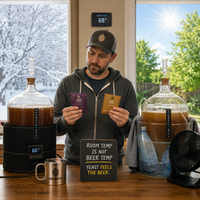
Fermentation Temperature Is Not Room Temperature
Posted by Matteo Lahm on 16th Jul 2026
When you choose a yeast strain, you are not just choosing a flavor profile. You are choosing a temperature range you need to maintain.
That matters because your brewing conditions change throughout the year. A basement that is ideal for an ale in January may be too warm in July. A cool room that makes fermentation easy in winter may require heating, while summer may force you to find ways to stop the beer from overheating.
Yeast is relatively inexpensive. Temperature-control equipment, ruined batches, and wasted time are not. Giving more thought to the strain you use can make fermentation easier and save you money.
Choose Yeast for the Conditions You Actually Have
Brewers often begin with a recipe and select the yeast traditionally associated with that style. That makes sense, but your ambient conditions should also influence the decision.
Suppose your brewing room stays around 62°F during the winter. You may have several good options for clean ale strains, hybrid yeasts, or strains that benefit from a cooler start. You also have more ability to control the heat produced by fermentation because the surrounding air can absorb some of it.
In summer, that same room may sit at 72°F or warmer. Now the situation is reversed. Fermentation will not cool the beer. It will make it warmer.
A strain that performs beautifully at 64°F may become excessively fruity, harsh, or unpredictable if the beer rises into the upper 70s. In that situation, you may need active cooling or a different yeast that tolerates warmer fermentation.
This does not mean you should ignore beer style. It means you should choose a strain that can produce the character you want under the conditions you can realistically provide.
The Beer Is Warmer Than the Room
During fermentation, yeast consumes sugar and produces alcohol and carbon dioxide. That activity also produces heat.
The more active the fermentation, the more heat it can generate. This is especially important during the first few days, when yeast growth and sugar consumption are at their peak.
A fermenter sitting in a 68°F room may contain beer fermenting at 72°F, 74°F, or even warmer. High-gravity beers and particularly vigorous yeast strains can create an even larger difference.
Your thermostat is not giving you false information. It is simply measuring the air on the other side of the room.
Yeast experiences the temperature of the beer.
That is the number that matters.
Why Excess Heat Changes the Beer
Warmer fermentation generally increases yeast activity, but faster fermentation is not always cleaner fermentation.
When yeast operates above its preferred range, it may produce excessive esters. These can taste or smell like banana, pear, apple, bubble gum, or tropical fruit. Some styles rely on these flavors, but they can be distracting in a beer meant to taste clean and crisp.
Excessive heat can also contribute to higher alcohols, often called fusel alcohols. These may create a hot, rough, peppery, or spirit-like character. At more extreme temperatures, you may encounter solvent-like notes resembling nail polish remover or paint thinner.
Depending on the strain, an overheated fermentation may also produce exaggerated phenolic, sulfurous, or generally rough flavors.
A beer does not have to taste obviously terrible for fermentation temperature to be a problem. Sometimes it simply tastes less refined than it should. The malt seems buried, the hops seem dull, and the yeast character dominates the glass.
Yeast Strains Do Not All Behave the Same
Every yeast strain has its own preferred temperature range.
A clean American ale strain may perform best in the mid-60s. An English strain may produce attractive fruit character at slightly warmer temperatures. Some Belgian and saison strains tolerate or even prefer heat that would make a lager yeast deeply unhappy.
Even closely related strains can behave differently. One may stay clean at 70°F while another becomes strongly fruity.
Read the manufacturer’s recommended range, but remember that it refers to the temperature of the fermenting beer, not the room.
If your summer brewing area is consistently warm, choosing a heat-tolerant strain may be more practical than fighting the environment through the entire fermentation. In colder months, a strain that performs well at lower temperatures may reduce the amount of heating you need.
The yeast packet may cost only a few dollars, but choosing the right one can eliminate a great deal of work.
Measure Where Fermentation Is Happening
Ambient room temperature is useful, but it is not enough.
An adhesive thermometer strip attached to the fermenter gives you a better estimate of the beer temperature. It is inexpensive and usually accurate enough to reveal a fermentation-related temperature rise.
A temperature probe taped to the side of the fermenter can work well when insulated from the surrounding air with foam or folded fabric.
A thermowell provides a more direct measurement. It allows a probe to extend into the fermenter inside a sealed tube, giving you a reading much closer to the beer’s internal temperature. This is especially useful with automated temperature controllers.
The closer your measurement is to the beer, the more useful it becomes.
Work With the Season
In winter, your challenge may be keeping fermentation warm enough. Heating wraps, fermentation belts, insulated chambers, or temperature-controlled heating pads can help.
In summer, you are more likely to need cooling. A water bath can absorb some of the fermentation heat. Wet towels draped over the fermenter can provide evaporative cooling, especially when paired with a fan. Frozen water bottles can be rotated through the bath to bring the temperature down further.
For precise control, a refrigerator or freezer connected to an external temperature controller remains the most reliable option.
Whatever method you use, plan for the temperature rise before fermentation begins.
If you want the beer to ferment at 68°F, placing it in a 68°F room may already be too warm. You may need to begin a few degrees cooler so the natural heat of fermentation brings the beer up to your target instead of carrying it beyond it.
The first few days are when temperature control matters most. Once the beer has already overheated, cooling it back down cannot erase the flavors the yeast produced during the warmest stage.
Choose your yeast with your room, your season, and your equipment in mind. The cheapest fermentation-control tool may be the strain you select before you ever open the packet.