
How Much Oxygen Does Your Wort Really Need?
Posted by Matteo Lahm on 14th May 2026
There is a moment in every brewer’s life when the hobby stops being “boil sugary grain tea and hope for the best” and becomes something sharper, stranger, and more satisfying. Maybe it happens after your first stalled imperial stout. Maybe it happens when your Belgian golden strong finishes sweet and hot instead of dry and elegant. Maybe it happens when your yeast looks at a 1.085 wort and says, “Friend, you brought me to a knife fight with a pool noodle.”
That moment often leads to one overlooked question:
Did you give your yeast enough oxygen?
Most newer brewers learn that wort needs to be aerated before fermentation. You shake the fermenter, splash the wort, stir with enthusiasm, or let it tumble into the bucket like a caffeinated waterfall. That can work beautifully for ordinary-strength beers. But once you start brewing bigger beers, “some oxygen” may no longer be enough. You need to start thinking not just about whether you add oxygen, but about how much oxygen your wort actually needs.
That is where your original gravity becomes your map.
Aeration vs. Oxygenation: Same Goal, Different Muscle
Before we get into the calculation, let’s clear up the language.
Aeration means adding regular air to your wort. Air contains oxygen, but only about a fifth of it is oxygen. The rest is mostly nitrogen, standing around like it was invited to the party but forgot to bring snacks. When you shake, splash, stir, or pump filtered air through a stone, you are aerating.
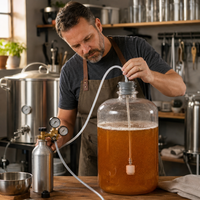
Oxygenation means adding pure oxygen. Usually, this involves an oxygen tank, regulator, tubing, and a diffusion stone. Instead of asking regular air to lend you a little oxygen, you are bringing in the bottled lightning directly.
Both methods aim to do the same thing: dissolve oxygen into cooled wort before fermentation begins. But they are not equal in strength. Aeration is simple, cheap, and often good enough. Oxygenation is more powerful, more precise, and especially useful when the beer gets big.
And big beers are where many up-and-coming brewers begin to stumble.
Why High-Gravity Beers Need More Oxygen
Yeast needs oxygen early in fermentation to build strong cell membranes. Healthy cell membranes help yeast reproduce, tolerate alcohol, and finish the job cleanly. Without enough oxygen, your yeast may struggle to multiply, slow down, quit early, or throw off-flavors like acetaldehyde, diacetyl, or harsh fusel alcohols.
A moderate pale ale may forgive a lazy shake of the fermenter. A barleywine will not. A barleywine has the patience of a tax auditor and the appetite of a mythological beast.
As original gravity rises, two things happen at once. First, your yeast has more sugar to ferment, which means more work and more stress. Second, oxygen becomes harder to dissolve into denser wort. So the beers that need more oxygen are often the same beers that make oxygen harder to dissolve.
Brewing, like life, occasionally enjoys a cruel little joke.
The Simple Rule: 1 ppm per Degree Plato
Here is the practical technique every improving brewer should know:
Aim for about 1 ppm of dissolved oxygen per degree Plato.
That sounds technical, but it is easy to use.
Degrees Plato measure how much extract, mostly sugar, is dissolved in your wort. You can convert original gravity to Plato with brewing software, but for quick homebrew math, use this shortcut:
Degrees Plato ≈ gravity points ÷ 4
Gravity points are the numbers after 1.000. So:
1.048 = 48 gravity points
48 ÷ 4 = 12
So a 1.048 wort is roughly 12°P, which means your oxygen target is around 8–12 ppm.
Let’s make it practical.
| Original Gravity | Approx. Plato | Oxygen Target |
|---|---|---|
| 1.040 | 10°P | About 8–10 ppm |
| 1.048 | 12°P | About 8–12 ppm |
| 1.060 | 15°P | About 12–15 ppm |
| 1.080 | 20°P | About 16–20 ppm |
| 1.100 | 25°P | 20+ ppm, handled carefully |
This is not laboratory gospel carved into a stone tablet by a yeast prophet. It is a working rule. Your exact needs also depend on yeast strain, pitch rate, wort temperature, yeast health, and whether you are brewing an ale or lager. But as a brewer’s compass, it points in the right direction.
The Catch: Air Usually Tops Out Around 8 ppm
Here is where the aeration-versus-oxygenation difference really matters.
Air can only take you so far. Since air is only about 21% oxygen, basic aeration has a practical ceiling. In many homebrew situations, vigorous aeration may get you into the neighborhood of 8 ppm dissolved oxygen, but it will not reliably push you far beyond that.
That means aeration can work well for a 1.040 or 1.050 beer. You can shake, splash, stir, or use filtered air and likely give your yeast enough oxygen to get moving.
But if your wort is 1.070, 1.080, or higher, air may not get you where you need to go. You might shake that fermenter like it owes you rent and still fall short. Your yeast will begin fermentation with weak knees, a wrinkled map, and no snacks for the road.
This is why some brewers have mixed results with high-gravity beers. They may build a great recipe. They may mash well. They may pitch a decent yeast strain. But if they treat a 1.085 wort like a 1.045 pale ale, fermentation can stall, drag, or finish too sweet.
The missing piece may be oxygen.
How to Use the Technique in Your Brewery
Start with your original gravity.
Let’s say you brew a strong ale at 1.080.
That is 80 gravity points.
80 ÷ 4 = 20°P.
Using the 1 ppm per degree Plato rule, your wort may need around 20 ppm dissolved oxygen.
Now ask: can aeration get you there?
No. Not reliably. Air generally tops out around 8 ppm. For this beer, pure oxygen is the better tool.
For a 1.050 pale ale, the math looks different.
50 ÷ 4 = 12.5°P.
Your target is roughly 8–12 ppm. In that case, vigorous aeration may be enough, especially if you pitch healthy yeast.
This is the heart of the method: gravity tells you when simple aeration is probably fine and when pure oxygen starts becoming important.
A Practical Gravity-Based Approach
For beers under about 1.060, good aeration is usually enough. Splash during transfer, shake the fermenter, stir with a sanitized spoon, or use filtered air through a sanitized stone.
From about 1.060 to 1.075, oxygenation becomes more useful, especially for clean styles, lagers, or yeast strains that need more support.
Above 1.075 or 1.080, pure oxygen becomes less of a luxury and more of a fermentation insurance policy. At that point, your yeast is being asked to climb a mountain while carrying a piano. Give it boots.
For very high-gravity beers, some brewers use a second oxygen dose within the first several hours of fermentation, before yeast activity is too advanced. This should be done carefully. Oxygen before fermentation is useful. Oxygen after fermentation is underway can become the villain, bringing stale, papery flavors and long-term oxidation problems.
Oxygen Tank Safety: Do Not Treat Bottled Lightning Like a Toy
Pure oxygen is incredibly useful in brewing, but it deserves respect. Oxygen itself is not flammable, but it vigorously supports combustion. That means materials that might normally burn slowly can ignite more easily and burn more intensely in an oxygen-rich environment. In other words, oxygen does not start the party, but once fire shows up, it hands the drummer a chainsaw.
If you use an oxygen tank, keep it away from open flames, burners, pilot lights, cigarettes, sparks, and hot surfaces. Do not oxygenate wort next to a running propane burner. Do not store the tank beside your brew kettle, furnace, water heater, or anything else that could turn a small mistake into a memorable neighborhood event.
Store the tank upright and secure it so it cannot tip over. A pressurized cylinder with a damaged valve is not brewing equipment anymore; it is a physics lesson with bad intentions. Keep the protective cap on when appropriate, and do not drag, drop, or bang the cylinder around.
Keep oil and grease far away from oxygen fittings. This is important. Do not lubricate oxygen regulators, valves, threads, or connections with household oils, keg lube, or mystery goo from the drawer of forgotten tools. Oil and high-concentration oxygen can be a dangerous combination.
Use equipment intended for oxygen. That means an oxygen-compatible regulator, tubing, and fittings. Open the valve slowly. Check connections. Follow the manufacturer’s instructions. When you are finished, close the tank valve, bleed pressure from the line if your setup allows it, and store everything clean, dry, and secure.
And, of course, sanitize anything that touches your wort: tubing, diffusion stone, wand, stopper, and any other contact surface. Safety keeps you intact. Sanitation keeps your beer from becoming a microbial swamp opera.
Pure oxygen can improve your beer, especially as gravity climbs, but only if you handle it like a tool instead of a toy. Treat the tank with calm, sober respect, and it will help your yeast without trying to rearrange your garage.
The Bottom Line
Aeration and oxygenation are not just equipment choices. They are fermentation strategy.
Aeration is good for many everyday beers. Oxygenation is the better choice when gravity rises and yeast stress increases. The simple rule is to estimate degrees Plato from your original gravity, then aim for about 1 ppm of dissolved oxygen per degree Plato.
Once you understand that, oxygen stops being a vague instruction and becomes a measurable part of your brewing process.
And that is how your craft improves: not by chasing shiny gadgets, not by worshiping stainless steel under a full moon, but by learning what your yeast needs and giving it the right conditions to perform.
Treat your yeast like a serious brewing partner, and it will stop behaving like a disgruntled tenant. Give it enough oxygen at the start, especially in bigger beers, and it can reward you with cleaner fermentation, better attenuation, and beer that finishes the way you imagined when you first scribbled the recipe on a napkin and thought, “Yes. This one might be magnificent.”