
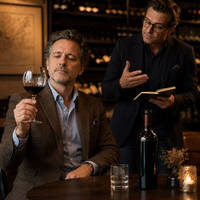
No One Can Taste It for You
Posted by Matteo Lahm on 18th Jun 2026
I usually try to keep myself out of these articles. Not because I do not have opinions, but because your beer and winemaking aspirations should be the center of the conversation, not me.
But every so often, a subject comes along that almost requires a personal answer. This is one of those times.
I recently read an article about Bordeaux falling out of favor, even in Bordeaux itself, and I have to admit, it bothered me more than I expected. Not because every wine drinker needs to love Bordeaux. They do not. Taste does not work that way. But because it reminded me how easily people can be talked out of trusting their own palate.
That problem is much bigger than Bordeaux.
It happens with wine. It happens with beer. It happens with art. It happens any time fashion, critics, marketing, movies, social pressure, or simple insecurity convinces people that what they enjoy is somehow wrong. I fundamentally disagree with that.
Bordeaux has always been one of those wines that surprises me, more than any other, in fact. It is not loud like a Brunello di Montalcino or Barolo, but those are wines with predictable parameters. This is not the case with Bordeaux. For me, every bottle has been an unexpected adventure. It is not always immediate. Sometimes the pleasure is a whisper: cedar, graphite, dark fruit, tobacco, herbs, earth, structure, or some savory edge that is hard to name but easy to remember. Bordeaux always asks me to pay attention. For me, that is part of its charm.
So when I hear that Bordeaux is becoming “unfashionable,” my concern is not that every wine drinker should rush back to Bordeaux. It is that wine culture has a habit of turning yesterday’s greatness into today’s embarrassment.
We have seen this before with Merlot.
Merlot did not suddenly become worse because of Sideways. The grape did not change. The vineyards did not change. The long history of Merlot did not collapse because a movie character mocked it. But the cultural story changed. Merlot became a punchline.
The absurd part is that the insult was taken entirely out of context in the movie. In the book, Miles did not reject Merlot because of some objective, technical, qualitative judgment. Merlot was his ex-wife’s favorite wine. His reaction was personal, but if you only saw the film, you would not know that.
Think about how strange that is. A fictional character’s private heartbreak helped make real people embarrassed to order or enjoy an entire grape. That is not palate. That is fashion doing the drinking for you.
Beer has its own version of this.
It has become popular in some circles to bash beers like Budweiser, as if light lager is automatically beneath serious beer drinkers. I have always thought that was foolish. A clean light beer is one of the hardest beers to make well. There is nowhere to hide. No heavy roast character to cover flaws. No big hop charge to dominate the aroma. No thick malt body to soften mistakes. Everything has to be clean, balanced, and precise.
And on a hot day, that kind of beer is often exactly what I want.
There is nothing wrong with loving bold beers. IPAs, stouts, Belgian ales, barrel-aged beers, sours, and complex specialty beers all have their place. There is nothing wrong with loving big red wines, obscure grapes, natural wines, old-world classics, or strange little bottles nobody else has heard of.
But complexity does not automatically equal superiority. Intensity does not equal quality. Popular does not imply mediocre. Unfashionable does not intrinsically mean wrong.
Your taste buds are allowed to tell the truth, and the only person to whom they must answer is you.
That sounds basic, but it is amazing how often people forget it. They stop asking, “Do I enjoy this?” and start asking, “Am I supposed to enjoy this?” Those are very different questions.
The first question belongs to you. The second belongs to the crowd.
Having a background in art, I have seen a similar thing happen there. In some corners of the art world, people are trained to distrust their own reaction. If they do not understand a work, they are made to feel unsophisticated. If they are not moved by it, they are told they must not “get it.” The viewer becomes the problem.
But that has always struck me as backwards.
Art is meant to be beheld. Wine and beer are meant to be savored. All of them can be subtle, difficult, or challenging. But if any of them require humiliation as the price of admission, something has gone very wrong.
A painting should communicate something, even if that something is mysterious, uncomfortable, or hard to name. A wine or beer should offer something too: pleasure, intrigue, refreshment, structure, memory, surprise, comfort, beauty, or even a useful lesson.
Experts can help with that. A good critic, brewer, winemaker, sommelier, artist, teacher, or experienced hobbyist can help you notice more. They can teach you vocabulary. They can explain details and context. They can introduce you to things you might never have discovered on your own.
That kind of guidance is valuable.
But guidance should sharpen your senses, not replace them.
A good expert helps you understand what you are experiencing. A bad one makes you feel embarrassed for experiencing something different.
For home wine and beer makers, this matters even more. Making your own wine or beer already puts you closer to the truth than most consumers ever get. You are not just buying a finished product and absorbing the story around it. You are watching fermentation happen. You are tasting at different stages. You are learning what yeast does, what aging changes, what balance feels like, what flaws taste like, and how small decisions affect the final result.
That process should make you more confident, not less.
Of course your palate can grow. It should grow. You may come to appreciate styles you once ignored. You may move away from things you used to enjoy. You may learn to detect flaws you never noticed before. That is part of becoming a better taster.
But growth is not the same thing as surrender.
You do not need to abandon your own pleasure to prove you are sophisticated. You do not need to dislike Merlot because a movie made it trendy to sneer at it. You do not need to mock light lager to prove you understand craft beer. You do not need to apologize for liking Bordeaux, Merlot, Chardonnay, Cabernet, pilsner, cream ale, or anything else that gives you real enjoyment.
The glass does not care what is fashionable.
The beer does not care what the crowd thinks.
The wine does not know whether it is trending.
It either gives you pleasure, or it does not. That experience is real and belongs only to you.
So listen to critics. Learn from experts. Try new styles. Challenge your palate. Stay curious.
But do not outsource your taste.
Others cannot taste a wine or beer for you, nor should they.