
Why Metric Makes Beer and Winemaking Easier
Posted by Matteo Lahm on 12th Nov 2026
Your Wine Has Enough Problems Without Fractions
I was preparing to move my Sangiovese Merlot into FlexTanks for bulk aging when calculating the acid and sulfite additions gave me an unexpected insight into the value of the metric system. After years in Italy, I had finally found a reason to get excited about grams and liters: they make the arithmetic so simple that I wondered why I had spent so long wrestling with ounces and fractions of teaspoons. Apparently, I needed 240 liters of wine to teach me something a fourth grader could have explained. Decimals, grams and liters are awesome.
In my earlier article about acidulated water, I explained that I had kept the acid addition conservative. Adding more later is generally easier than dealing with an excess. You can invite a little more acid to the party. Getting it to leave is another matter. Now it was time to see where that decision had left the wine.
What the Sample Told Me
During tasting, the tannins and alcohol seemed to be overpowering the fruit. Think of two loud guests cornering someone who actually has something interesting to say. This is a substantial wine, over 14.5% alcohol, with two weeks on the skins. I suspected that the acidity was insufficient for its structure and guessed the titratable acidity would fall between 5.5 and 6 grams per liter.
The test showed approximately 6.
That number alone would not condemn another wine. In this particular batch, however, it was falling short. I prepared a sample with enough tartaric acid to bring the calculated TA to 6.5 grams per liter. The fruit finally got a turn at the microphone. The wine felt more balanced, and the improvement was substantial.
Then we calculated the addition for the full batch.
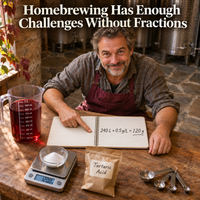
240 liters × 0.5 grams per liter = 120 grams of tartaric acid.
That was when the light bulb went on. Titratable acid is calculated by grams per liter. Increasing the acidity by half a gram per liter required half as many grams as there were liters. No fractions of ounces. No negotiating with a teaspoon. Just 240 multiplied by 0.5. The wine had spent two weeks on its skins; the calculation barely needed a moment.
Why are we not talking more about this?
Familiar Does Not Always Mean Easier
I lived in the United States for most of my life. Pounds, ounces, and gallons still feel familiar. After years in Italy, I have learned metric because I had to. You can only look blankly at the person behind the counter for so long before learning what a kilogram is. This calculation, however, gave me a reason to appreciate it.
We Americans can debate a pitcher’s earned run average to three decimal places and calculate a tip while arguing about who ordered the appetizer. Present us with a liter, and suddenly we need an adult. I include myself in this. Familiarity is a powerful thing.
I understand the hesitation. Familiar measurements let us visualize quantities quickly. But you do not have to picture 240 liters instinctively to multiply it by 0.5.
For calculating additions, metric is simply a better tool.
The Units Cooperate
There are 1,000 milligrams in a gram, 1,000 grams in a kilogram, and 1,000 milliliters in a liter. Moving between those units means multiplying or dividing by 1,000. The decimal point moves. Nobody needs to find a common denominator or call the nephew who is good at math.
There is also a useful connection between water’s weight and volume: one liter of water weighs approximately one kilogram. One milliliter weighs approximately one gram.
That relationship does not transfer exactly to wine, wort, or concentrate because their densities differ. Nevertheless, it makes water quantities easy to understand and measure.
Compare that with weight ounces versus fluid ounces, 16 ounces per pound, and 128 US fluid ounces per gallon. An ounce arrives, and your first question is whether it is here to weigh something or fill something. We have given two different jobs the same name and left the recipe reader to sort out the staffing.
For my acid addition, the dose was already expressed in grams per liter. Keeping the batch volume in liters meant the units lined up immediately. At last, something in the cellar was cooperating on the first attempt.
Sulfites Follow the Same Principle
The sulfite calculation offered another example. For a nominal addition of 20 ppm SO₂ to my 240 liters, the arithmetic starts with the winemaking convention that 20 ppm is approximately 20 milligrams per liter.
240 liters × 20 milligrams per liter = 4,800 milligrams.
Divide by 1,000, and that becomes 4.8 grams of SO₂.
Potassium metabisulfite powder theoretically supplies 57.6% of its weight as available SO₂. Therefore:
4.8 grams ÷ 0.576 = approximately 8.3 grams of potassium metabisulfite.
The product’s strength adds a step, but that step exists in any measurement system. Potassium metabisulfite sounds like something you should need a laboratory coat and a grant to understand. For this calculation, you need its available SO₂ percentage and a calculator. The name is doing most of the heavy lifting.
I manage sulfites throughout bulk aging, maintaining adequate free SO₂ while avoiding unnecessary additions that increase the total sulfite burden. The 20 ppm shown here is one calculated addition, rather than my entire treatment through bottling. Additions must be guided by pH and measured free SO₂. The calculation gives SO₂ added, not a guaranteed final free SO₂ reading. Virginia Tech explains the chemistry and addition calculations here.
Brewers Can Use This Too
Brewers, this is your round too. Once an appropriate dose is established, priming sugar, brewing salts, and nutrients can be calculated and scaled in metric units.
Suppose a particular priming calculation calls for 5 grams of a specified sugar per liter. For 20 liters of beer:
20 × 5 = 100 grams.
That rate is illustrative. Actual priming requirements depend on the sugar, beer temperature, and desired carbonation. Metric makes the arithmetic easier once you know the appropriate rate.
Small trials also become easier to scale. A treatment expressed per liter can be carried into the full batch without changing measurement systems along the way.
Let the Gram Scale Weigh In
You do not need to abandon gallons everywhere. Nobody is coming for your pint glass. Start by recording the actual volume of beer or wine you are treating in liters.
One US gallon equals approximately 3.785 liters. One kilogram equals approximately 2.2 pounds. Those two relationships cover much of the initial translation, although working directly in grams is usually more useful for small additions.
Use a gram scale with suitable resolution for the amount being weighed. Record the product, dose, and batch volume. A teaspoon measures volume, and different powders do not all weigh the same amount in that space. A heaping spoonful also depends rather heavily on the enthusiasm of the person holding the spoon.
Metric cannot choose the right addition for you. You still need measurements, sound judgment, and small trials where appropriate. My tasting identified a concern, the TA test established a starting point, and the treated sample demonstrated an improvement.
But once I knew the adjustment, calculating it was almost embarrassingly simple.
You can keep buying milk by the gallon and thinking about your weight in pounds. Nobody is asking you to order a 473-milliliter beer at the bar. But when it is time to calculate an addition, let grams and liters earn their place on the workbench. Your yeast already has a demanding job. Your calculator deserves an easy one. That is one less thing to wine about.